

Saturday, 16 April 2011
Newton Tiddly

Wednesday, 13 April 2011
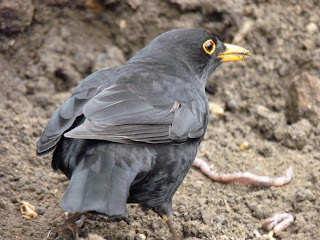
What a Mouthful.
This Blackbird was very confiding as I dug over a vegetable patch in an Olney garden today. It must have fairly well developed young, judging by the size of the worms it was collecting.


Monday, 11 April 2011
A Trip to the Manor
With everyone saying how good Manor Farm was looking lately, I took a look in this afternoon. It is starting to look good, but I was quite dismayed to see 5 people working on site. There has been a lot of tree planting going on recently so I'm not sure if that's what they were up to.
I needn't really have worried as there were still a few good birds on site. Definitely 4 Little Ringed Plovers, possibly 6, 2 Green Sandpipers, an Oystercatcher and 4 Lapwings were the waders on offer. Asingle Little Egret, 3 Gadwall, a few Mallards and a couple of Canada Geese made up the bigger stuff.
Spring migrants were well represented by Chiffchaffs, Blackcap, at least 5 handsome Yellow Wagtails, 30 or 40 Sand Martins, a dozen Swallows and a single House Martin.
Finally a Little Owl was calling from one of the pollarded Willows along the south shore
Thursday, 7 April 2011
A Work of Art
On one of my brief visits to Tongwell Lake last week I noticed a pair of Long-tailed Tits starting to build a nest. When I went back today it looks like it is finished. Click on the photo to see what a fantastic construction it is.


Tuesday, 5 April 2011
Dawn Raid
'OK Rob, here's our plan', Paul said to me on the phone last night. 'We both need Crane for our Buckinghamshire list, so we're off to Gallows Bridge Nature Reserve.'
'Be at mine for about quarter past five in the morning (this meant leaving home at five to ) We can be there at six o'clock and be in the hide for sun up. We'll find the Crane and watch it for half an hour or so and get back in time for work.'
Amazingly this was exactly how it went. Sitting in the hide as the darkness turned to green outside, with the sound of Lapwings, Curlews, Skylarks and Meadow Pipits all around. Gradually shapes turned into birds, several Hares and a Fox that scampered across the field in front of us. Finally it was light enough for Paul to pick out the smart adult Common Crane standing in the pool a couple of hundred yards right out in front of us. We did indeed watch it for half an hour or so, before setting off back towards Milton Keynes and Hardmead. I was back home by just after half seven, very pleased with my 200th bird for Bucks.
Monday, 4 April 2011
Hills and Ressies
With some free time today, I decided to explore the middle of the county.
I started off at Ivinghoe Beacon in the hope of seeing some migrants. A male Ring Ousel had been around for a week or so and I had hopes of seeing it. Walking down from the car park I was sure I could see my target bird in the distance and decided to get to a better vantage point. Only to find when I got there two idiot 'cameramen' stomping right up the area with absolutely no idea whatsoever that the bird had been there if they had just stood and looked.
It was another twenty minutes or so after they had wandered off up the hill, that I spotted the Ousel on the side of a bush, although the view was brief as it flew back into the scrub. Continuing my watch there were a few false alarms when a couple of Blackbirds came out, and then a brown bird that I first assumed was a female Blackbird, until it turned to face me showing a faded white necklace - a female Ring Ousel. So two for the price of one.
Other migrants in the surrounding bushes included Chiffchaffs, Willow Warblers and Blackcaps. As usual there were lots of Skylarks, Linnets and Meadow Pipits about and a couple of Buzzards.
Next stop was Startops and Marsworth Reservoirs where Mallards and Tufteds were the major inhabitants. I decided to have a look over the other side of the canal to see if there were any Yellow Wagtails fresh in. There were Wagtails but only about eight and all were Pied. There was a small flock of Jackdaws in the field, but one stood out from the rest. It had white patches on its shoulders - a 'Nordic' Jackdaw no less, pretty uncommon in these parts.
I then met Francis Buckle and while pointing out the Jackdaw to him he informed me of a Whitefronted Goose that had just arrived at nearby College Lake.
This was my next destination. I hadn't visited here since the site was redeveloped and I have to say it really is quite an impressive place.
There were at least half a dozen Redshanks, a pair of Oystercatchers and several Lapwings flying around and calling, most unlike Buckinghamshire.
The Whitefront was present, keeping the company of a single Greylag and it seemed they were in fact a pair. I don't know if it's origins are supect but it was certainly unringed.
I started off at Ivinghoe Beacon in the hope of seeing some migrants. A male Ring Ousel had been around for a week or so and I had hopes of seeing it. Walking down from the car park I was sure I could see my target bird in the distance and decided to get to a better vantage point. Only to find when I got there two idiot 'cameramen' stomping right up the area with absolutely no idea whatsoever that the bird had been there if they had just stood and looked.
It was another twenty minutes or so after they had wandered off up the hill, that I spotted the Ousel on the side of a bush, although the view was brief as it flew back into the scrub. Continuing my watch there were a few false alarms when a couple of Blackbirds came out, and then a brown bird that I first assumed was a female Blackbird, until it turned to face me showing a faded white necklace - a female Ring Ousel. So two for the price of one.
Other migrants in the surrounding bushes included Chiffchaffs, Willow Warblers and Blackcaps. As usual there were lots of Skylarks, Linnets and Meadow Pipits about and a couple of Buzzards.
Next stop was Startops and Marsworth Reservoirs where Mallards and Tufteds were the major inhabitants. I decided to have a look over the other side of the canal to see if there were any Yellow Wagtails fresh in. There were Wagtails but only about eight and all were Pied. There was a small flock of Jackdaws in the field, but one stood out from the rest. It had white patches on its shoulders - a 'Nordic' Jackdaw no less, pretty uncommon in these parts.
 |
| nordic jackdaw (click on the picture) |
 |
| nordic jackdaw (click on the picture) |
This was my next destination. I hadn't visited here since the site was redeveloped and I have to say it really is quite an impressive place.
There were at least half a dozen Redshanks, a pair of Oystercatchers and several Lapwings flying around and calling, most unlike Buckinghamshire.
The Whitefront was present, keeping the company of a single Greylag and it seemed they were in fact a pair. I don't know if it's origins are supect but it was certainly unringed.
 |
| white-fronted goose |
Sunday, 3 April 2011
Mothers Day Migrants
We were back up in Nottinghamshire to visit Angela's mum today. As usual I snuck out in the afternoon to look around Attenborough Nature Reserve.
Winter visitors had mainly disappeared, but there were still 5 female Goosanders on the Main Pit and about 8 Goldeneye around the site. Duck numbers were very much down, with Mallard the most numerous, followed by Tufted Duck. There were a pair of Shelduck and Red-crested Pochard, the female of which was the leucistic bird I had seen here last year, a few Shoveler, Teal and Gadwall.
There were also a few Egyptian Geese around including a partially leucistic individual.
Continuing the theme was this Canada Goose.
Good birds seen around the reserve were a pair of Willow Tits, 2 Oystercatchers and 10 or so Tree Sparrows, while 2 Cettis Warblers were heard but not seen.
It was however summer migrants that were here in force today, with many singing Blackcaps and Chiffchaffs, 20 or 30 Sand Martins, a dozen Swallows and 4 Common Terns.
Early nesters included Coots, Moorhens, and a pair of Kestrels in the nestbox in Wheatear Field.
Winter visitors had mainly disappeared, but there were still 5 female Goosanders on the Main Pit and about 8 Goldeneye around the site. Duck numbers were very much down, with Mallard the most numerous, followed by Tufted Duck. There were a pair of Shelduck and Red-crested Pochard, the female of which was the leucistic bird I had seen here last year, a few Shoveler, Teal and Gadwall.
 |
| Leucistic female Red-crested Pochard |
There were also a few Egyptian Geese around including a partially leucistic individual.
 |
| Egyptian Goose with leucistic head feathers |
Continuing the theme was this Canada Goose.
 |
| Canada Goose with partially leucistic neck feathers |
Good birds seen around the reserve were a pair of Willow Tits, 2 Oystercatchers and 10 or so Tree Sparrows, while 2 Cettis Warblers were heard but not seen.
It was however summer migrants that were here in force today, with many singing Blackcaps and Chiffchaffs, 20 or 30 Sand Martins, a dozen Swallows and 4 Common Terns.
Early nesters included Coots, Moorhens, and a pair of Kestrels in the nestbox in Wheatear Field.
Subscribe to:
Posts (Atom)