I took a walk around some waterside meadows - most local birders will know where I mean - this morning. It was a glorious spring morning and many birds were singing, including several Skylarks and a few Reed Buntings. Nineteen Barnacle Geese were present as was a Kestrel. Best birds seen however were 2 Curlews that were foraging in the long grass. One or two MeadowPipits made themselves known as I walked around the site.
At lunchtime I stopped off at Ravenstone Sewage Works to see if any migrants had dropped in. Again Skylarks were in full song and a flock of 17 Stock Doves were on the fields.
Down at the works 3 Grey Wagtails were present, along with 4 Pieds and 7 Reed Buntings. I then heard my first Chiffchaff of the year, which eventually showed itself in the company of 2 Long tailed Tits.
Further down the road I stopped to look over the floods near to Ravenstone Mill. The only bird of note here amongst the Black-headed Gulls was a lone Little Egret.
Near to to Gayhurst I stopped to examine some interesting road-kill, which I'm fairly sure was a Polecat.

Wednesday, 17 March 2010

Sunday, 14 March 2010
Attenborough
I never complain about having to visit my Mother-in-law, as this means I get a chance to visit Attenborough Nature Reserve in Nottinghamshire which is conveniently right next door. (you're alright really Chris)
Walking around the pits, a lot of common Ducks - Shoveler,Gadwall, Teal,Mallard and Tufteds Tufted Duck
 Tufted Duck
 Egyptian Goose
Walking around the pits, a lot of common Ducks - Shoveler,Gadwall, Teal,Mallard and Tufteds
 Tufted Duck
 Tufted Duck
At various points around the reserve, there are bird tables that are regularly topped up. Visitors to these included Great, Blue, Coal and Long-tailed Tits but not the hoped for Willow Tits that are usually seen.
Egyptian Geese are usually quite numerous around the place, but I could only find one today.
I hadn't realised it was ringed until I looked at the photo. If you click on the picture it is even possible to read most of the numbers on it.
 Egyptian Goose
Nearer to the visitor centre 2 pairs of Red-crested Pochard were mixing with the local Mallards.
 Red-crested pochard
 Red-crested Pochard.
 Red-crested pochard
 Red-crested Pochard.
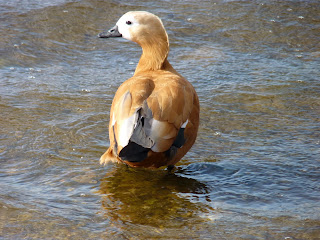
At the Visitor Centre it is possible to buy grain to feed the waterfowl. This has resulted in a lot of the birds becoming very human tolerant, including this female Ruddy Shelduck that moved in during last Autumn.
Ruddy Shelduck
 I then spent some time in the hides overlooking Clifton Pit.

Ruddy Shelduck
 I then spent some time in the hides overlooking Clifton Pit.
From the giant hide 2 Oystercatchers, 2 Shelduck, 10 Ruddy Ducks and a few Goldeneye were seen. We were then treated to the sight of a Bittern that flew right across the pit before plopping down into a patch of reeds.
Walking back down the side of the river, which skirts the reserve, around 30 Goosanders were on the main lake, with a few more Goldeneye.
This cheeky chappy seemed quite happy pretending to be a bird.
This cheeky chappy seemed quite happy pretending to be a bird.

Another Smew near miss !
A dawn trip to Linford failed to find the redhead Smew that had been around all day yesterday. I had been in Northampton doing my mothers day duty, so was unable to get there.
Not a total non event though as walking down the track I had an eyeball to eyeball encounter with a Buck Muntjac, with neither of us wanting to move first. He could obviously see me but couldn't pick up my scent, so stood his ground. In the end it was me who yielded as my time was limited and I wanted to get down to near hide.
From the hide there were lots of Duck, including, Teal, Tufteds, Pochard, Mallard, Gadwall and a few Wigeon. Several Great crested Grebe were present including a pair doing their 'weed dance'. Two Oystercatchers made a fly through appearance, but showed no sign of stopping.
Monday, 8 March 2010
Yoiks !
I managed a late afternoon visit to Gayhurst Quarry today.
Again the fields seemed to be full of Fieldfares, this time with quite a few Redwings mixed in with them.
The track down to the Pits was very active with bird life too, a flock of around 20 Reed Buntings being noteworthy.
Scanning the Fishing Pit I could see there were still large numbers of Wigeon, - I estimated over 500 - also around 50 Teal.
I then noticed a pair of Oystercatchers, amazingly my first of the year, and then another 3 appeared and settled quite close by.
A Little Egret was near the river, and in the field on the other side the Goose flock comprised of 250 Greylags, 50 Canadas and a single Egyptian.
Other Ducks present were around 50 Mallard, 50 Tufteds, 30 Pochard a few Gadwall and a female Pintail, which may well be a bird that was present in the autumn which I couldn't decide whether it was a young male or a female.
On the walk back up Marsh Tit was 'pitchou'ing just up from the wood.
Sunday, 7 March 2010
Tree Sparrows
Following up on some information from Rob Hill and Richard Billyard I went for a look around some farmland around the Castlethorpe/Bullington End area.
A lot of typical farmland species were present with both types of Partridge, Yellowhammers, Skylarks, Mistle Thrush, Green and Great Spotted Woodpeckers.
Rooks were very active in the small Rookery behind the Hatton Court Hotel and the fields were covered in Fieldfares.
Hares were very much in evidence, chasing each other across the fields and through hedges.
Taking the track down to the New Buildings Farm I was delighted to hear the chirping of a territorial Tree Sparrow which I managed to locate in a Poplar tree. Further up the track several more were singing in the hedge but these failed to come out and show themselves.
It later transpired that I was looking in the wrong place for Robs Tree Sparrows - he had 19 at a site some 4 kms away the previous day so it looks like we have 2 seperate flocks in the area. Good News and my 100th species in North Bucks this year.
Wednesday, 3 March 2010
Bucks' own Svalbard
......or Emberton Park as it is known.
A visit this morning showed that around 65 Barnacle Geese have returned to breed as they do each year. We have no idea where they disappear to in the winter. They are believed to be naturalised birds that derived from birds that escaped/were released when Weston Underwood Bird Gardens closed down in the early nineties.
Also present were 11 Goosanders of which only 3 were drakes, 5 Goldeneye which were all drakes, 3 Buzzards and a Kingfisher.
Monday, 1 March 2010
Ringo.
Having heard that the drake Ring-necked Duck had once again returned to Foxcote Reservoir, I thought I ought to pay him a visit before he disappeared for the summer.
A complete scan around the Reservoir failed to find him amongst the many Wigeon, Pochard and a few Tufted Duck and Gadwall. Although 13 Goldeneye were noted.
However a second sweep around and all of a sudden there he was, in with a group of Pochards, trying to get amorous with one particular female.
This very handsome bird has visited Foxcote for at least the past six winters and has had many admirers in that time.
On the way out a Grey Wagtail was walking around on the dam.
Subscribe to:
Posts (Atom)